Are US Financial Policies Mirroring The 1720 Mississippi Bubble?

Are US Financial Policies Mirroring The 1720 Mississippi Bubble?
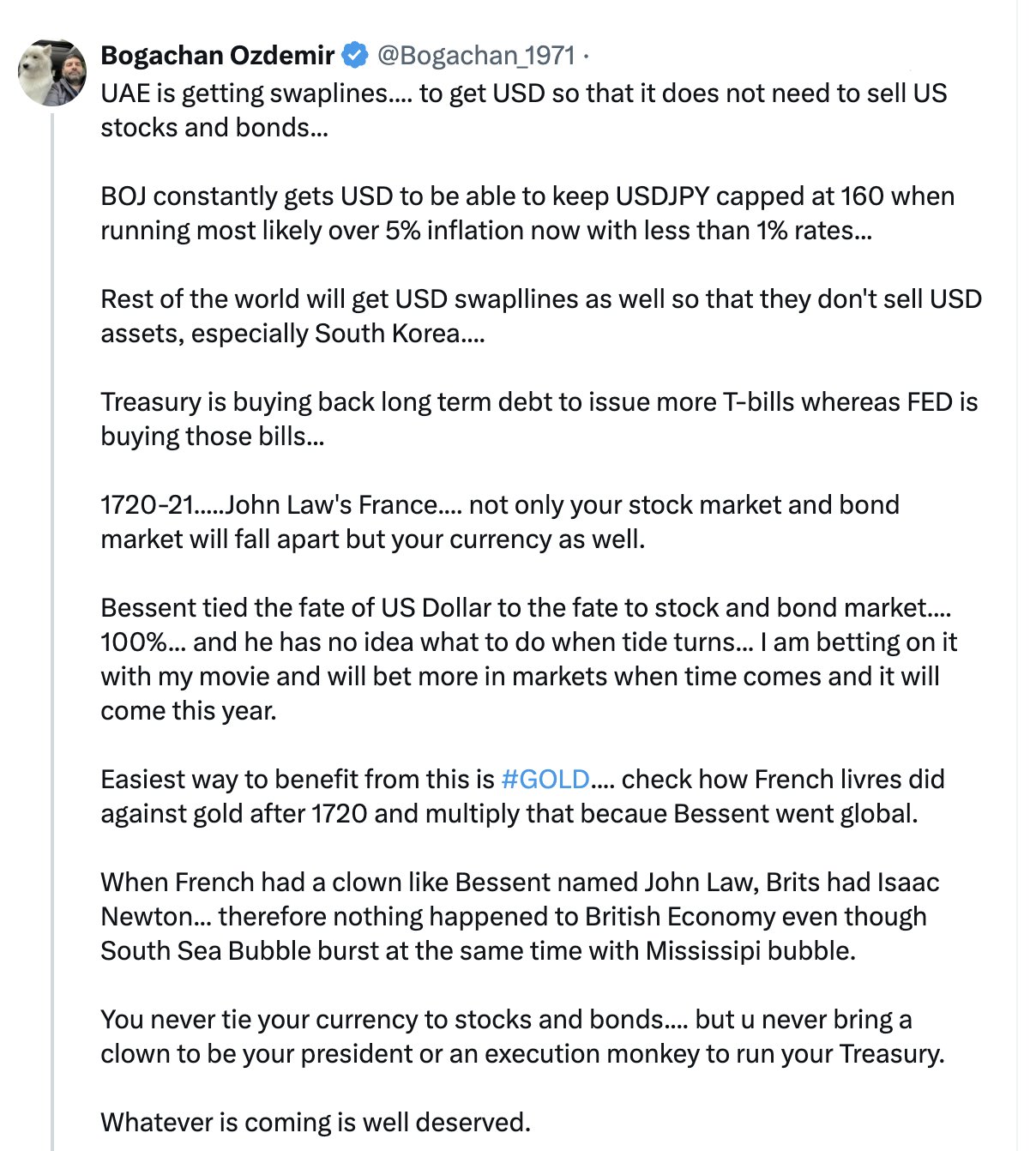
I came across this post that claims that the current US financial policies mirror the 1720 French Mississipi Bubble and suggests that Issac Newton saved Britain from major negative effects on the economy when the South Sea Bubble bust. It takes some strong conclusions based on arguments that are historically inaccurate.
While I understand the points regarding the Fed's balance sheet and I agree that it may be an issue. Generally speaking, I also equally oppose sovereign debt monetization by the central bank. However, I disagree that US/USD is in the same position as France/Livre in the 18th century. This is a good opportunity to go over some financial history of United States, France, Britain and even Isaac Newton:
1️⃣ France didn't have an international reserve currency in 1721, at that time the Spanish Dollar (the original “dollar”!) dominated international trade. So you cannot compare the United States Dollar in 2026 to French Livre in 1721 -- international reserve currencies are much more resilient to shocks. You cannot ignore the international status of a currency when reasoning about its demise. In several occasions, leading trade/reserve currencies outlived the sovereigns that created them (see example of Roman Denarius -- but again, it was commodity money, not paper FIAT). USD can survive a lot more "garbage on the balance sheet" than Ruble, and that's in big part due to the demand for USD-denominated instruments. US Treasury Debt instruments are the most desired financial collateral in the world -- it will take more than Bessent to destroy that privilege.
2️⃣ Newton was a master at the Royal Mint and he worked on coins, not the British economy. He also happened to miscalculate the market ratio between gold and silver (Britain was on a bimetallic standard), which had negative consequences on the British economy -- since gold was overvalued and silver undervalued, Gresham's Law kicked in and silver left Britain, with little silver coins remaining in the country. Arbitrage isn't free, so Britain would've been better off without an arbitrage opportunity on its money.
3️⃣ The South Sea Bubble of 1720 absolutely caused significant negative effects in the British economy. In fact, Isaac Newton lost an equivalent to several millions of USD when that bubble burst. The Pound did better than Livre because it was commodity money (gold/silver), while Livre was FIAT/paper, and consequently British economy recovered faster than French. It wasn't because Britain "had Newton".