Crue Oil: United States Acts, Russia Benefits (Once Again)

Crue Oil: United States Acts, Russia Benefits (Once Again)
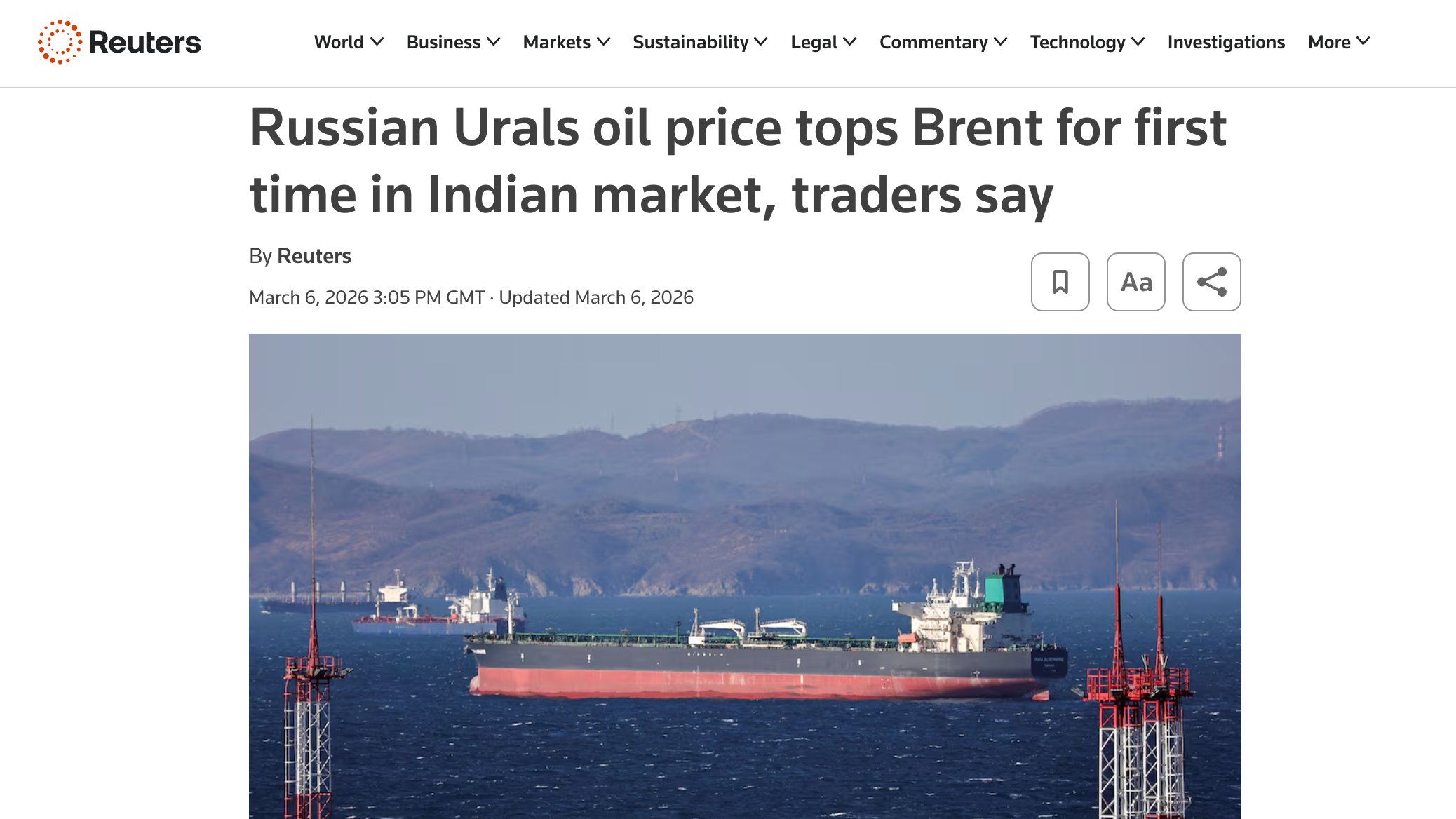
Despite the heavy international sanctions, Russia is now selling Urals oil at a ≈$5 premium over Brent oil. Usually, Urals trades at a discount to Brent, so this is a relatively unusual situation. This is, of course, caused by the U.S. military force use against a sovereign nation once again.
While oil production and export from the Arab Gulf region has now greatly reduced, the demand for oil didn't follow that downtrend. 20% of all oil passes Straight of Hormuz, the flow through which is now heavily limited. As a result, a significant part of that demand has now shifted towards Russia, which is capitalizing on that demand by selling crude oil, not only for a higher price, but also at a premium!
High oil prices are also great news for Ruble. More than ≈50% of Russian oil exports are in foreign currencies, but exporters must pay their taxes in Rubles. As such, exporters must sell foreign currencies to purchase Ruble, which drives its price up. Additionally, since 2020 Russia has policies in place which cause high oil prices to usually lead to further accumulation of gold by the Central Bank of Russia (CBR): excess revenue from taxes resulting from oil sales above ≈59$/barrel are directed to the NWF for investing in precious metals (mostly gold) and FX (mostly renminbi/yuan). So instead of spending the extra revenue immediately, it gets invested.
The mechanism by which the FX & gold purchase happens from excess gas and oil revenues is also interesting to explore. NWF is administrated by Russia’s Ministry of Finance (MoF), and it’s effectively MoF doing those purchases on behalf of NWF. So every time revenues from oil and gas taxes exceed the benchmark price, the MoF buys foreign assets and gold from the CBR, which then immediately repurchases what it had just sold to the MoF/NWF. As a result of this sanitization mechanism, the Central Bank of Russia net holdings of gold/FX currencies remain constant, while the net asset holdings of the NWF increase — so in net terms the Russian government holds more gold and FX.
Imagine on a given period Russia recovered an extra revenue of $100M over the benchmark. Under the structure described above, the Russian government will not immediately spend those $100M, but instead invest them into gold & FX currencies. The step-by-step process looks something like this:
1. MoF buys $40M worth of gold from the CBR
2. CBR repurchases $40M worth of gold from domestic Russian market, using the proceeds from 1
3. MoF buys $60M worth of renminbi from the CBR
4. CBR repurchases $60M worth of renminbi from FX markets, using the proceeds from 2
As you can see, the combination of steps above leaves Russia with more gold and FX reserves than before.
For the month of March 2026, the Russian Federation has paused the gold/FX purchases from excess revenue from oil and gas. However, I don’t think that this pause will remain in effect much longer, as it has been explicitly linked to lowering the Ural’s oil revenue threshold from the current ≈$59 per barrel, potentially down to $45-50 per barrel. For now, all of the excess revenue from oil and gas will be going to the federal budget, available for its immediate liquidity needs.
So whichever way you look at it — Russia massively benefits from the raise in price of commodities and precious metals, namely gas, oil, gold and silver.